Projection Mapping Previsualization for the 7th CISM Military World Games: Cutting a 3-Day Commissioning Process to Under 1 Day
Published
- Projection Mapping
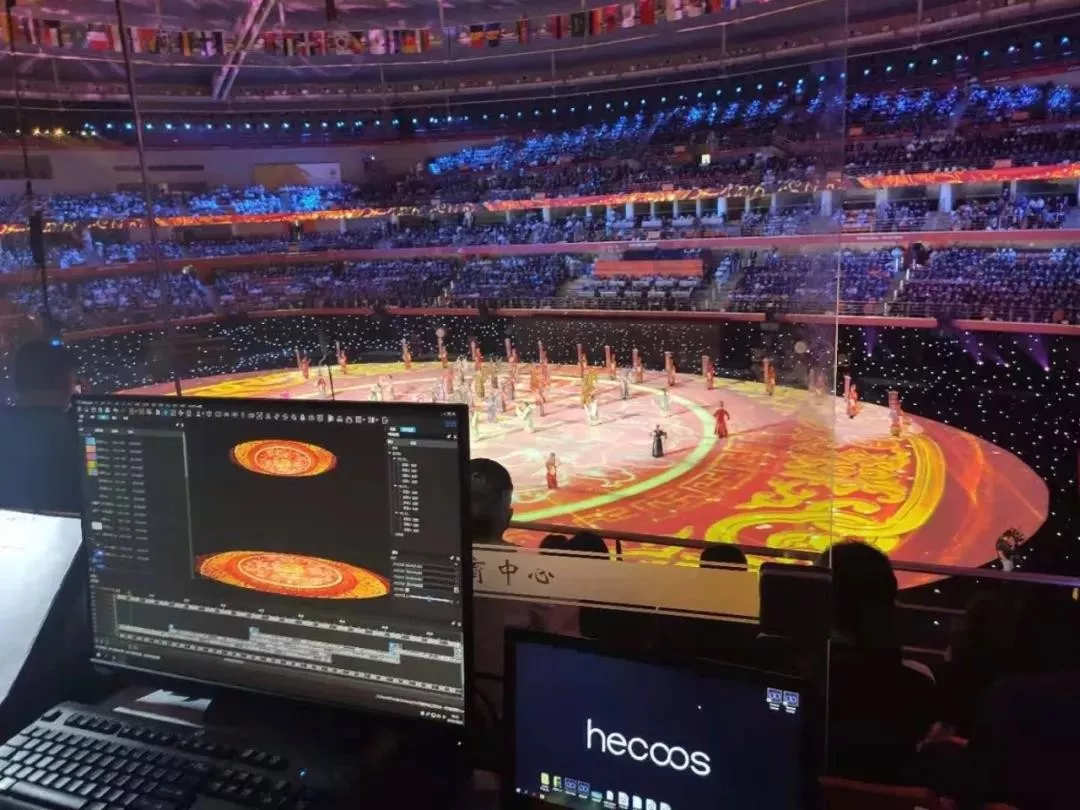
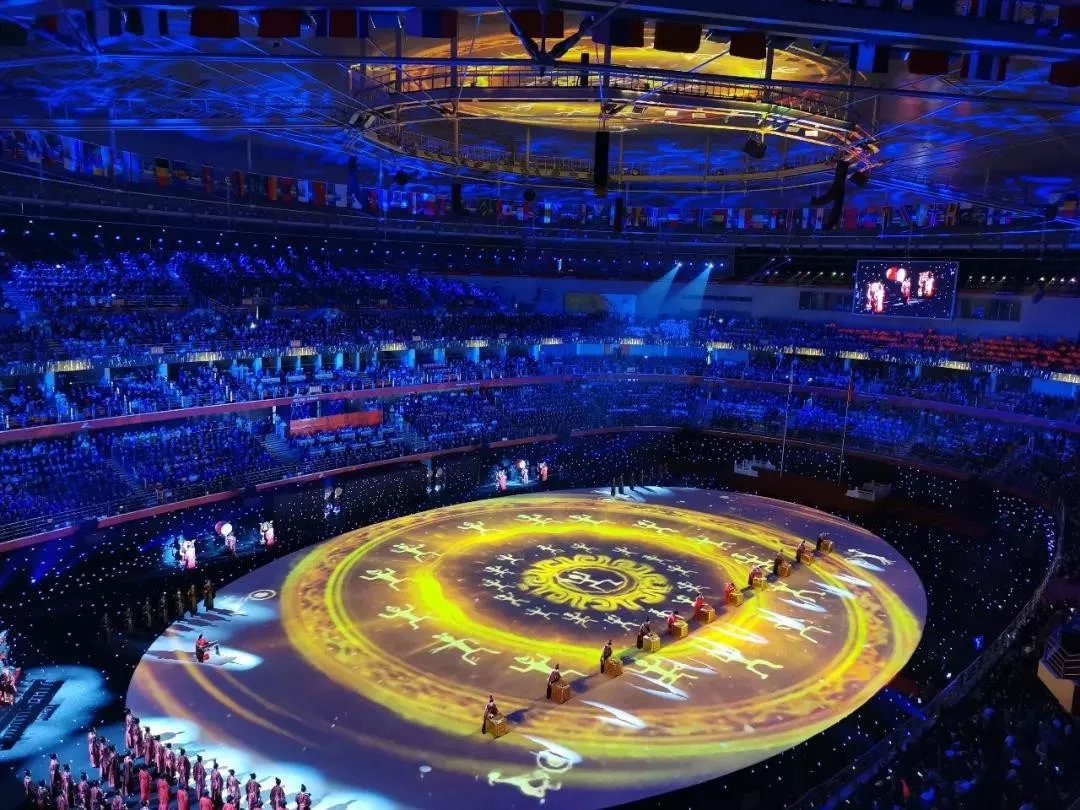
The closing ceremony of the 7th CISM Military World Games, held in Wuhan on October 27, 2019, was built around the theme “Ties of Friendship” and staged across two chapters. Drawing from Jingchu cultural heritage and Wuhan’s visual identity, the performance combined traditional artistic elements with large-scale digital stage technology, delivering a complex audiovisual production broadcast to a global audience.
To transform the venue into a seamless projection canvas, the production deployed 47 projectors across the ground stage and overhead dome. Coordinating this 8-layer ground array and 3-layer dome array would become one of the project's greatest engineering challenges.
Project Overview
| Element | Detail |
|---|---|
| Project | 7th CISM Military World Games — Closing Ceremony Projection Control |
| Timeline | October 18 (Opening Ceremony) – October 27 (Closing Ceremony), 2019 |
| Equipment Scale | 47 projectors total |
| On-site commissioning window | Cumulative time available: under 3 days |
| Actual commissioning time | Full system tuning completed in 1 day |
| Playback hardware | 3×hecoos servers (each supporting up to 24× 2K projectors at full load) |
Core technologies | Pre-visualization & simulation, 3D-mapping-based pre-blending, LTC-timecode-driven non-linear playback |
Challenge
In conventional large-scale projection workflows, calibration begins only after projectors are physically installed at the venue. Teams must wait until the final rigging positions are confirmed before they can start correcting optical paths, aligning projected images, blending overlapping areas, balancing brightness, and integrating playback content. Every adjustment depends on what is physically visible on site.
For smaller projection systems, this approach may be manageable. But for a multi-layer array like the Military World Games Closing Ceremony, the number of variables increases dramatically.
The 47 projectors were arranged across multiple overlapping layers, requiring precise coordination between geometric alignment and brightness consistency. Each projector had to match its neighboring outputs perfectly, while extreme projection angles introduced additional distortion and brightness loss.
The schedule made the challenge even more demanding. Projector rigging was completed only eight days before the performance. After accounting for transportation, installation, rehearsals, and other production requirements, the team had less than three days of actual commissioning time.
Within that limited window, they needed to complete the entire calibration process and integrate all show content, leaving almost no room for unexpected issues. Yet, the traditional workflow created a fundamental problem: The most complex part of the project had to be solved during the shortest available time period.
Solution
hecoos changed the commissioning workflow by moving a large portion of calibration work away from the venue and into a pre-visualized engineering environment. Using hecoos Studio and hecoos Server, the team recreated the venue conditions, projector layout, and optical parameters before physical installation was completed.
Based on the actual stage dimensions and planned rigging positions, the team simulated projector output in advance, including:
- projection geometry and distortion caused by different throw angles
- image overlap between multiple projectors
- blending areas between adjacent outputs
- brightness distribution across the projection surface
Instead of discovering calibration problems after arriving on site, the team could identify potential issues beforehand, test different solutions, and refine the system remotely.
This effectively extended the available calibration window from several hours on site to days of preparation before installation. When the team arrived at the venue, the goal was no longer to start calibration from scratch. The physical commissioning stage became a process of verification, adjustment, and optimization.
Faster Multi-Layer Calibration Through Pre-Validated Solutions
The 8-layer ground projection structure was one of the biggest technical challenges. In a traditional workflow, engineers would need to adjust each projector while simultaneously observing its relationship with surrounding outputs. Changes to one area could affect neighboring projection zones, making the process highly iterative.
Through hecoos Studio’s 3D mapping workflow, projector calibration tools, inverse projection calculation, and mesh warping functions, the team completed much of the geometric preparation before arriving at the venue.
This significantly reduced on-site adjustment time. The complete image-stacking calibration across all eight ground projection layers was completed within 12 hours on site, allowing the production team to move quickly into final preparation.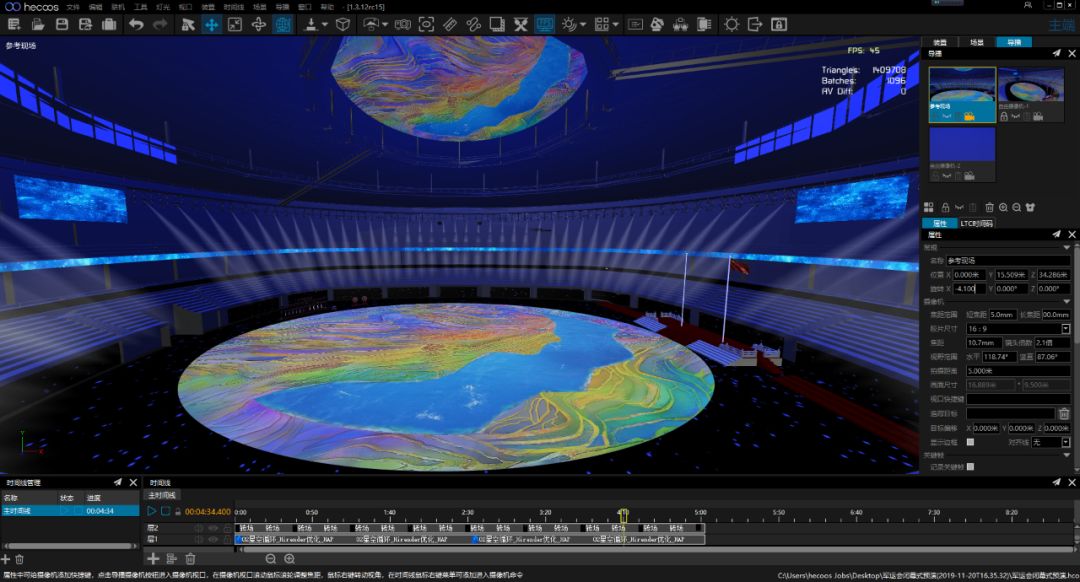
Streamlined Playback Management for a Complex Show
Projection calibration was only one part of the challenge. A large-scale ceremony also requires thousands of media assets to be played at precise moments, often across multiple projection surfaces simultaneously.
hecoos Server integrated LTC timecode synchronization with a non-linear timeline workflow, allowing operators to organize content across multiple tracks and maintain precise timing relationships between visual elements. Instead of managing individual playback cues manually, the team could build, review, and adjust the entire show timeline in a structured workflow, making it easier to coordinate complex sequences, identify timing conflicts, and implement last-minute changes with confidence.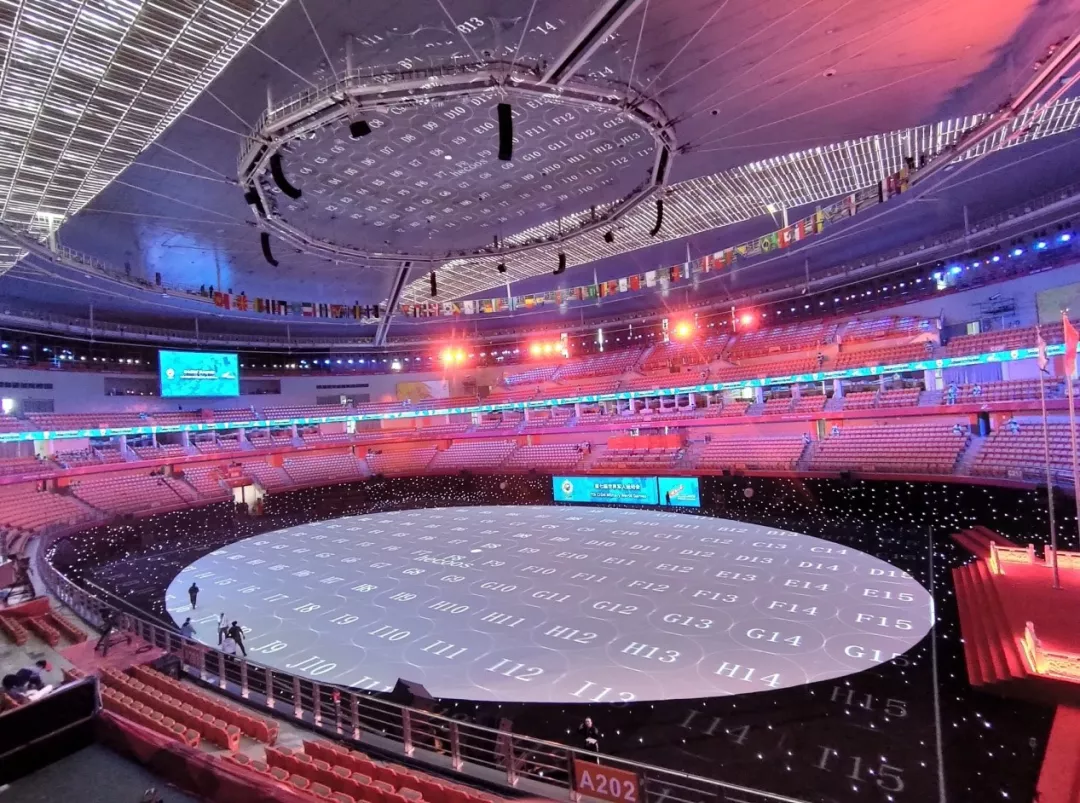
Reduced Hardware Complexity With Multi-Channel Output
Driving 47 projectors traditionally requires a large number of playback systems, increasing transportation, installation, and troubleshooting requirements.
hecoos Server reduced the hardware footprint through high-density output capabilities and flexible signal distribution. Each server supports multiple 4K output channels and can work with video-splitting workflows to distribute one high-resolution output into multiple projector feeds.
Using this architecture, the entire 47-projector system was synchronized through only three hecoos servers, reducing equipment complexity and minimizing potential failure points during a high-pressure production.
Result
The system achieved complete calibration and content integration within the available commissioning window, with the final image-stacking calibration completed in only one day of on-site tuning. The closing ceremony proceeded as scheduled without technical incidents.Beyond the successful delivery of the ceremony, the project demonstrated the value of shifting projection commissioning from a venue-dependent process to a pre-visualized engineering workflow. Proven under the compressed schedule and operational demands of a nationally televised event, this approach enables teams to reduce on-site commissioning pressure, extend the available engineering window, and deliver greater confidence across complex multi-projector installations.